


Before Transformers existed, AI systems struggled with understanding long pieces of text.
Imagine reading a novel and trying to remember something that happened 100 pages earlier. Humans can usually connect those details naturally.
Traditional AI models found this extremely difficult.
Earlier language models processed words one after another, almost like reading through a tiny keyhole. As sentences became longer, the model gradually forgot important information from earlier parts of the text.
For example, consider this sentence:
"The trophy didn't fit into the suitcase because it was too big."
What does the word "it" refer to?
Humans immediately understand that "it" refers to the trophy.
Older AI systems often struggled with these types of contextual relationships, especially when dealing with longer documents.
Researchers needed a better way for machines to understand relationships between words regardless of where they appeared in a sentence.

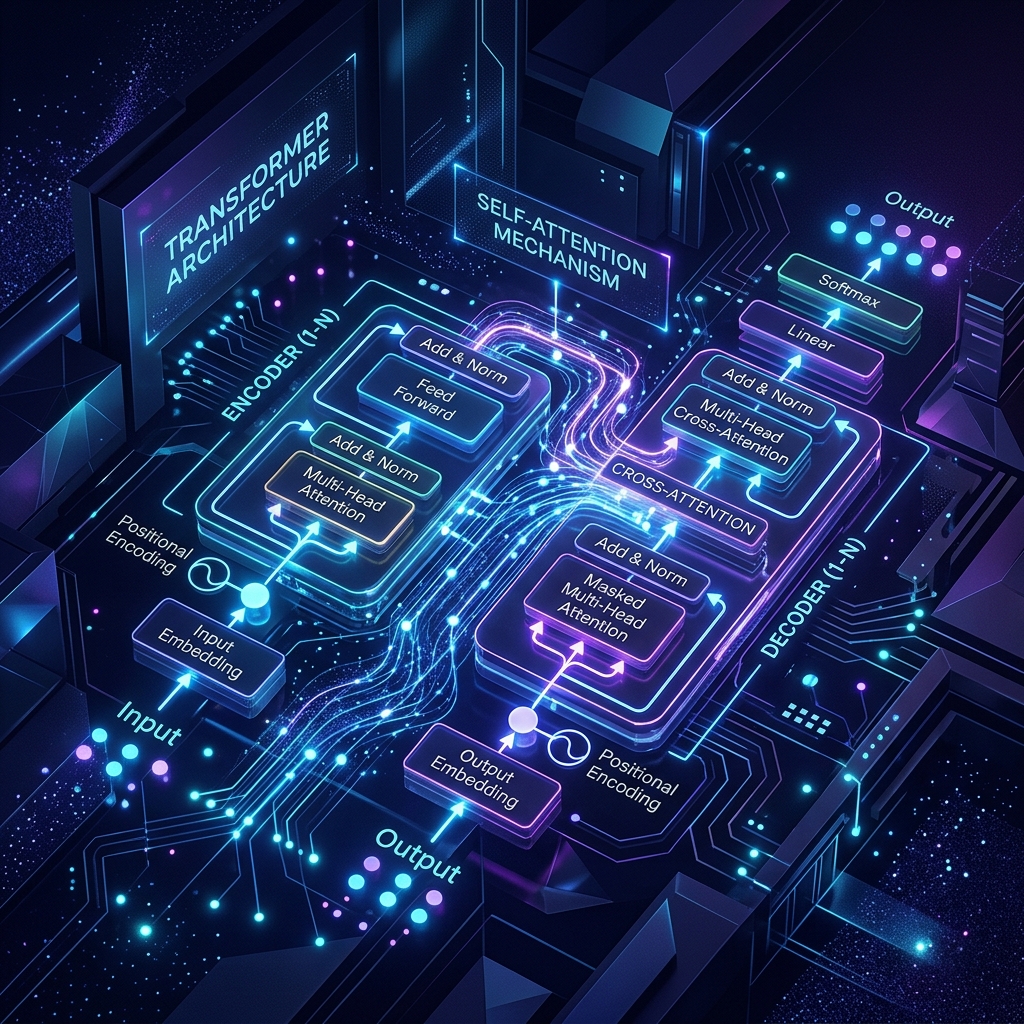
The researchers behind "Attention Is All You Need" proposed a surprisingly elegant idea.
Instead of forcing the AI to process words one by one, what if every word could directly "look at" every other word in the sentence?
This concept became known as Attention.
Think of attention as a student sitting in a classroom.
When the teacher asks a question, the student doesn't focus on every word spoken throughout the day. Instead, they pay attention to the specific information that helps answer the question.
Similarly, the Transformer model learns which words are important and which words can be ignored.
When analyzing a sentence, the AI automatically determines where it should focus its attention.
This allows the model to understand context much more effectively than previous approaches.
At first glance, this might not sound revolutionary.
But the impact was enormous.
Because Transformers could process information more efficiently, researchers could train significantly larger AI models using much larger datasets.
Bigger models meant better performance.
More training data meant greater knowledge.
Better understanding of context meant more natural responses.
The result was an entirely new generation of AI systems capable of understanding and generating human language with remarkable accuracy.
Without the Transformer architecture, modern conversational AI simply would not exist.

When OpenAI started developing its GPT models, the company built directly upon the Transformer architecture introduced in the research paper.
GPT stands for Generative Pre-trained Transformer.
Notice the last word?
Transformer.
Every GPT model—from GPT-1 to ChatGPT—uses the fundamental concepts introduced by the researchers in 2017.
The same technology powers:
In other words, one research paper became the foundation for an entire industry.
The influence of this research extends far beyond chatbots.
Today, Transformer-based AI systems are used in countless applications.
Modern search engines use Transformer models to better understand user queries and deliver more relevant results. When you search for information online, AI helps determine what you actually mean—not just what words you typed.
Services like Google Translate have become significantly more accurate because Transformer models understand context rather than translating individual words. This leads to translations that sound more natural and human.
AI-powered writing assistants can generate articles, emails, reports, and summaries because they understand patterns in human language. These capabilities stem directly from Transformer technology.
Researchers are using Transformer-based models to analyze medical records, assist with diagnoses, and accelerate scientific discoveries.
Coding assistants can now generate and explain code because they understand programming languages in a way similar to how they understand human language.

Thousands of AI papers are published every year.
Most improve existing systems by a small percentage.
Very few fundamentally change the direction of technology.
"Attention Is All You Need" is considered revolutionary because it introduced an entirely new approach to language understanding.
Researchers around the world quickly adopted the Transformer architecture because it consistently outperformed older methods.
Today, nearly every major advancement in Generative AI can be traced back to this single breakthrough.
That level of influence is incredibly rare in scientific research.

The biggest lesson from this research paper is that innovation doesn't always come from making systems larger or more complex.
Sometimes, a simple idea can change everything.
The researchers asked one important question:
"What if we let the model focus only on the most relevant information?"
That question led to the development of Transformers, which ultimately enabled ChatGPT and the modern AI revolution.
For students interested in Artificial Intelligence, understanding Transformers is one of the most valuable concepts you can learn because it sits at the heart of today's most powerful AI systems.

When people talk about ChatGPT, they often focus on the product itself.
But behind every breakthrough technology lies years of research and experimentation.
The 2017 paper "Attention Is All You Need" may not have received widespread public attention when it was first published, but its impact has been extraordinary.
It solved a critical problem in language understanding, introduced the Transformer architecture, and laid the foundation for the AI tools that millions of people use every day.
The next time you ask ChatGPT a question, generate an image, summarize a document, or write a piece of code, remember that it all started with a group of researchers who believed that attention might be all an AI system really needed.
And as history has shown, they were absolutely right.